

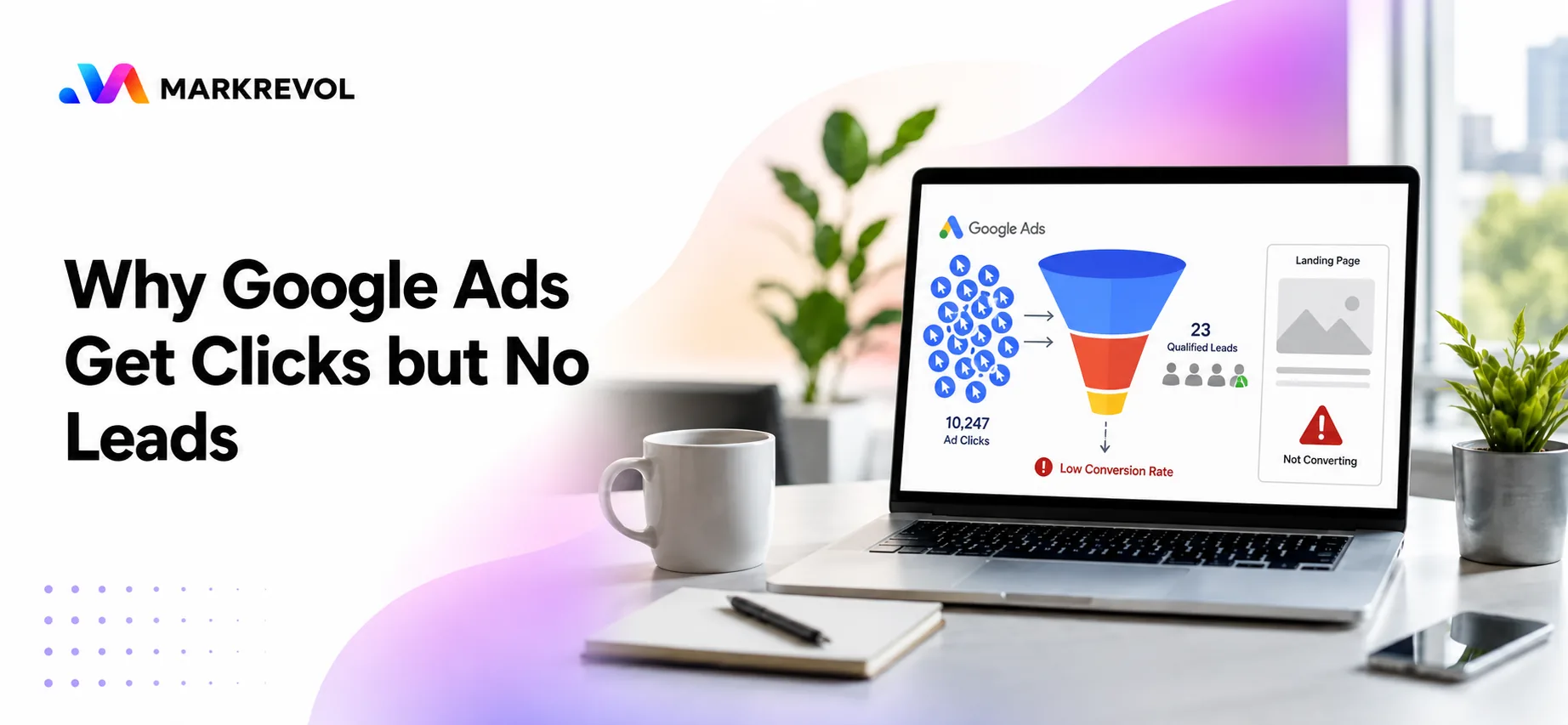
Google Ads can generate clicks without leads when the campaign attracts the wrong intent or the experience after the click fails to build enough relevance and trust. The issue is rarely one setting. It usually appears somewhere between the search query, ad promise, landing page, tracking, and sales response.
Fixing the problem starts with identifying where qualified prospects leave the journey.
1. The search intent is wrong
A keyword can look relevant while attracting people who want information, jobs, free resources, or a different service. Review the actual search terms, not only the keywords in the account. Separate commercial searches from research and exclude patterns that do not match the offer.
Pay special attention to ambiguous terms. A word used by your industry may have another common meaning. Search term review should continue throughout the campaign because new queries appear as traffic grows.
2. Match types are too broad
Broad match can discover useful demand, but it can also expand beyond the business’s intent when conversion signals are weak. Use a deliberate mix of match types, negative keywords, audience signals, and campaign structure.
Do not judge a keyword only by click volume. Compare it with qualified forms, calls, bookings, and customer outcomes. A smaller term that produces real opportunities is more valuable than a popular term that creates curiosity.
3. The ad and landing page do not match
The visitor clicked because the ad made a promise. The landing page must continue that message immediately. If the ad offers a specific service but the page opens with a broad company introduction, the visitor may assume the business is not relevant.
Align the headline, service, location, proof, and call to action with the ad group. Use dedicated pages when different services have different buyer needs.
4. The offer is weak or unclear
A page can describe a service accurately and still fail to answer why someone should choose it now. Clarify the result, process, audience, and next step. Add real proof such as reviews, credentials, case examples, warranties, or transparent expectations when available.
Avoid vague calls to action. Tell the visitor what will happen after submitting and what information is required.
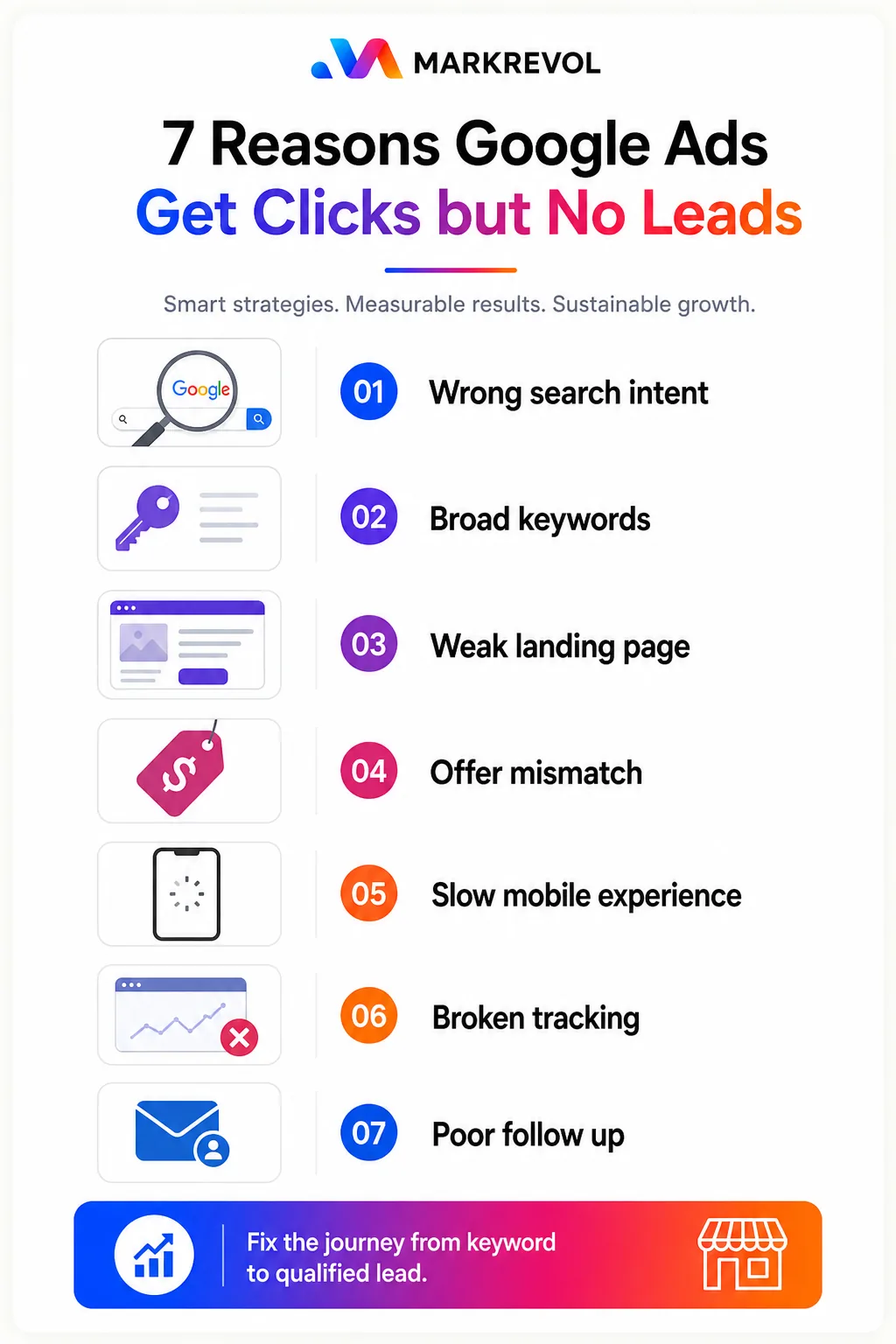
5. Mobile speed or usability creates friction
Many searchers arrive on phones. Slow pages, overlapping elements, small text, intrusive popups, or long forms can stop them before conversion. Test the complete path on a real mobile device, including tap to call, validation messages, and the confirmation page.
MarkRevol’s conversion focused website design helps align landing pages with the campaign promise and user journey.
6. Conversion tracking is incomplete
Sometimes leads exist but reporting misses them. Forms may submit without firing the event, phone calls may use untracked numbers, or a conversion may be assigned to the wrong source. Duplicate events create the opposite problem.
Submit every form, call every tracked number, and complete every booking flow. Confirm events in Tag Manager, analytics, the advertising account, and the lead system. Count meaningful outcomes as primary conversions.
7. Follow up loses the opportunity
Paid search often captures people comparing several providers. If calls are missed or forms wait too long, the campaign may have delivered a valid lead that never received an effective response.
Record response time, contact attempts, qualification, and loss reasons. Marketing and sales need a shared definition of lead quality. This feedback helps the campaign optimize toward users who are more likely to become customers.
A practical diagnosis sequence
First, verify tracking. Second, review search terms and segment performance by device, location, time, campaign, and landing page. Third, compare the ad promise with the page. Fourth, test the form and call experience. Finally, review real lead records with the sales team.
Change one meaningful variable at a time when possible. Large simultaneous changes make it difficult to understand what improved performance. MarkRevol’s PPC management team can help audit the full route from keyword to qualified lead.
Our guide to small business digital marketing also explains how landing pages, tracking, and follow up connect across channels.
Frequently asked questions
Why do I get clicks but no conversions?
The campaign may target the wrong intent, use broad queries, send users to a mismatched page, present an unclear offer, load poorly on mobile, or track conversions incorrectly. Review the complete journey before assuming the ads cannot work.
How many clicks should produce a lead?
There is no universal ratio. Conversion rates vary by service, market, device, price, offer, brand trust, and landing page. Use your own qualified conversion data and customer economics instead of an unrelated benchmark.
Can a landing page fix poor Google Ads performance?
A better page can improve relevance and conversion, but it cannot repair irrelevant traffic by itself. Search intent, campaign targeting, ad message, page experience, tracking, and follow up must work together.
Should I pause keywords with no leads?
Review search terms, cost, intent, sample size, and assisted value first. Pause or refine terms that consistently spend without qualified outcomes. Do not make a final decision from a handful of clicks when the service normally has a long consideration cycle.
How do I know if tracking is broken?
Complete a controlled test for every form, call, booking, and purchase. Confirm that one real action creates one correctly labeled conversion in each relevant platform and appears in the lead system with the correct source.