

Google Ads can be worth it for a small business when customers actively search for the offer, conversions are tracked, the landing page is persuasive, and the budget is large enough to collect useful data. It is not automatically profitable just because the ads receive clicks.
Paid search buys immediate access to search demand. Whether that access becomes revenue depends on targeting, the offer, the website, follow up, and customer economics.
When Google Ads are a strong fit
Google Ads works best when people already know what they need and search with commercial intent. Services such as repairs, legal consultations, home improvements, and urgent professional help often have clear search demand. The platform can place a relevant offer in front of those prospects at the right moment.
A strong fit also requires a valuable conversion. If one new customer can justify a reasonable acquisition cost, the campaign has room to compete. Businesses with very low margins may need higher conversion rates or repeat purchases to make the numbers work.
What must be ready before launch
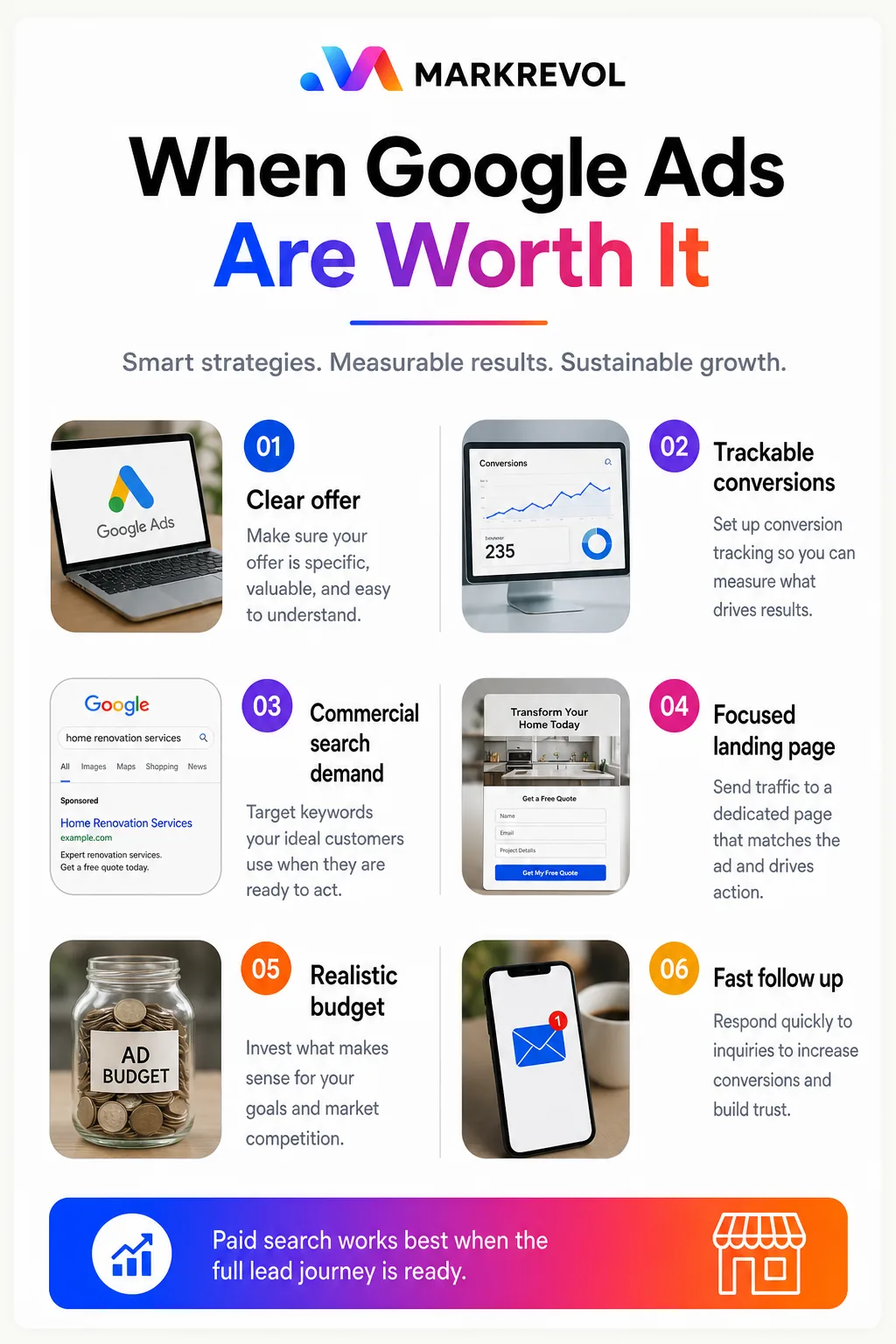
A specific offer
The ad and landing page should explain what the business provides, who it is for, and why someone should take the next step. Sending every campaign to a generic homepage makes the visitor work too hard.
Reliable conversion tracking
Track qualified forms, phone calls, bookings, purchases, and other real outcomes. Test each event before spending heavily. Clicks without conversion data encourage decisions based on assumptions.
A focused landing page
The landing page should match the keyword and ad promise. It needs a clear headline, useful proof, mobile speed, simple contact options, and a visible call to action. MarkRevol’s website design services focus on creating pages that support both usability and conversion.
Fast lead follow up
A paid search lead can contact several businesses. Slow or inconsistent follow up wastes media budget even when the campaign works. Decide who responds, how quickly, and how lead quality will be recorded.
How to estimate whether the numbers can work
Start with the maximum amount you can reasonably pay to acquire a customer. Consider gross profit, repeat business, close rate, and operational capacity. Then work backward to the value of a qualified lead.
If one in four qualified leads becomes a customer, the business can usually pay less for each lead than the profit from that customer divided by four. Use conservative assumptions. Early campaigns often need testing before the real cost and conversion rate become clear.
Common reasons small businesses waste budget
Broad targeting can attract research, job seekers, do it yourself searches, and people outside the service area. Weak negative keywords allow irrelevant queries to continue. Poor ad groups combine unrelated services, which reduces message relevance.
Another problem is optimizing for clicks instead of qualified conversions. Automated bidding can only learn from the signals it receives. If the account counts page views or low value actions as primary conversions, the system may pursue the wrong users.
Google Ads and SEO can work together
Paid search can generate demand while SEO builds a durable organic presence. Search query data can reveal how prospects describe problems, while strong SEO content can educate visitors who are not ready to contact the business immediately.
Our overview of digital marketing for small businesses shows how paid and organic channels can support the same customer journey. MarkRevol also provides PPC management services for campaign structure, tracking, testing, and optimization.
How long should a test run?
The test should run long enough to gather meaningful clicks and conversions, but there is no universal duration or budget. Search volume, click costs, conversion rate, and sales cycle affect the answer. Set decision rules before launch, review search terms frequently, and avoid changing every setting at once.
Google Ads is worth it when the campaign creates profitable customers or reliable strategic value. It is not worth maintaining merely because impressions and clicks look active.
Frequently asked questions
How much should a small business spend on Google Ads?
The budget should reflect expected click costs, conversion value, search volume, and the number of conversions needed to learn. Start with an amount the business can test responsibly, then scale only when tracking and lead quality support the decision.
Can Google Ads work with a small budget?
Yes, when targeting is narrow and the offer has enough value. A very small budget in a highly competitive national market may produce too little data. Focus on priority services, locations, schedules, and high intent queries.
How quickly do Google Ads produce results?
Ads can begin receiving visibility soon after approval, but profitable optimization takes longer. The account needs reliable conversion data, search term review, ad testing, and landing page improvements before performance becomes stable.
Are Google Ads better than SEO?
They solve different timing and ownership needs. Ads can create immediate visibility while spending continues. SEO takes longer but can build lasting organic assets. Many businesses use both to balance short term demand and long term growth.
Why are my Google Ads expensive?
Costs can rise because of competition, broad targeting, weak relevance, poor landing pages, low conversion rates, or bidding for queries with limited value. Review customer economics and the full conversion journey, not click cost alone.